Relationship manager co-pilot
Relationship managers were juggling dozens of customer relationships at once, each with its own history, paperwork and next step. I led the co-pilot piloted with 500 of them—and secured funding to scale to 5,000.
Increase in suggestion acceptance
Outreach preparation, down from roughly 30 minutes
Projected benefits supporting scale to 5,000 relationship managers
01 The problem
Relationship managers juggled dozens of customers while histories, goals and open items remained scattered across systems, emails and notes. Preparing one outreach took roughly thirty minutes. The opportunity was to assemble the context and draft a response without replacing the relationship manager's judgment.
I no longer have to open ten tabs to understand what happened with a customer, then spend fifteen minutes writing an outreach. The co-pilot does it in two minutes.
Relationship manager
02 What I built
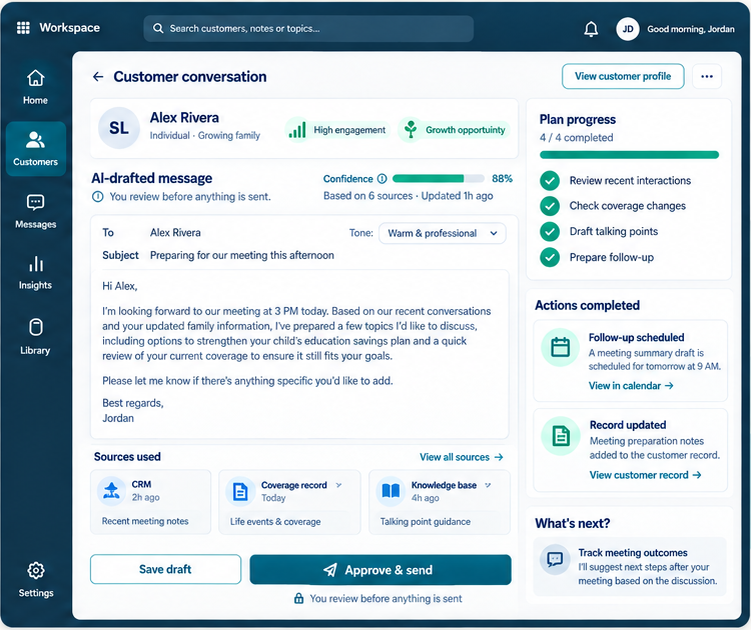
I led a cross-functional team of more than ten to build a prioritized day planner, customer-insight panel and reply-drafting workspace, then piloted it with 500 relationship managers. Each recommendation explains the signals behind it, and every message remains subject to human review.
Sanitized screen example to protect client confidentiality
03 Key decisions
Decision 01
Response confidence over suggestion frequency
Setting a response-confidence threshold so the co-pilot surfaced only higher-confidence recommendations, then letting relationship managers dismiss or rate them.
Maximizing suggestion frequency by showing every possible trigger and asking relationship managers to separate meaningful opportunities from noise.
The tradeoff produced a smaller set of credible recommendations, increasing suggestion acceptance by thirty percentage points while building greater user trust and adoption.
Decision 02
LLM-assisted priority over manual triage
A ranked queue in which the co-pilot weighs several customer signals, then explains both the recommendation and the evidence behind it.
Asking each relationship manager to review every open relationship and decide whom to contact first using judgment alone.
No single rule captured priority. The LLM combined several signals, while explanations made its reasoning inspectable. The tradeoff was inconsistent rankings and initial skepticism from relationship managers.
Decision 03
Draft-and-approve over fully automated replies
The co-pilot drafts a reply for the relationship manager to review and send; it never sends on its own.
A genuinely considered version that sent AI-generated outreach without human review.
Review protected accuracy and compliance, preserved relationship nuance and kept relationship managers in control—critical to adoption.
04 Outcome
A pilot with 500 relationship managers increased suggestion acceptance by thirty percentage points, while outreach preparation fell from roughly thirty minutes to under five. The business case projected $35M in benefits from greater customer-facing time and lower administrative costs, securing C-suite funding to scale to 5,000 relationship managers.
Next, I would start with fewer, higher-value triggers before expanding recommendations.
Confidentiality note
This project was built within McKinsey & Company. Specific client names, proprietary architectures, and internal tooling details are confidential. What's shared here reflects the publicly describable scope of the work; product screens shown are generic, illustrative recreations, not the shipped product.