Requirements extraction agent
A Fortune 100 platform rebuild was four months behind, and requirements had become the immediate bottleneck. I joined midway through the turnaround and built an agent that cut each epic from weeks to days—without removing the product owner's judgment.
Requirements throughput
Time to produce each epic
Engineers served downstream
01 The problem
I joined a Fortune 100 platform modernization that was four months behind. The immediate bottleneck was requirements: each build-ready epic took two to three weeks to extract from incomplete legacy documentation, while more than thirty engineers waited downstream.
02 What I built
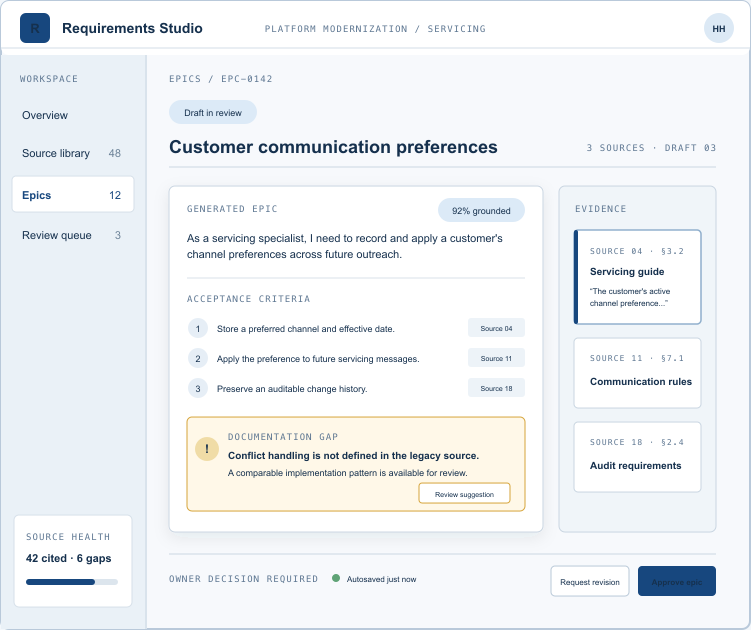
I built an agent that extracts source material, drafts epics and stories, and flags documentation gaps. Suggested gap-filling content stays separate from source-backed requirements, and product owners must review and approve every draft.
Sanitized screen example to protect client confidentiality
03 Key decisions
Decision 01
Source truth before synthetic completeness
Treating legacy documentation as authoritative, explicitly flagging gaps and separating analogous-system suggestions until a product owner approved them.
Allowing the model to silently fill missing requirements and present the result as source-backed.
The team had to distinguish documented requirements from AI proposals, while product owners remained accountable for every business decision.
Decision 02
Human approval over straight-through automation
A fast drafting and revision loop in which product owners approve every requirement before engineers receive it.
Automatically converting generated requirements into build work without product-owner review.
Requirements depended on business judgment, not extraction alone. Keeping owners accountable was also essential to adoption.
Decision 03
Out-of-the-box capability before customization
Using the target platform's standard features by default and customizing only when a capability created genuine competitive differentiation.
Reproducing every legacy behavior through custom development.
The rule focused engineering capacity on genuine differentiation and avoided long-term complexity for standard workflows.
04 Outcome
Requirements throughput increased more than eightfold: each epic fell from two to three weeks to one to two days across more than ten product owners. Removing that bottleneck recovered the program's four-month schedule delay.
If I built it again, I would define draft accuracy, edit distance and approval-rate measures from the start.
Confidentiality note
This project was built within McKinsey & Company. Specific client names, proprietary architectures, and internal tooling details are confidential. What's shared here reflects the publicly describable scope of the work; product screens shown are generic, illustrative recreations, not the shipped product.